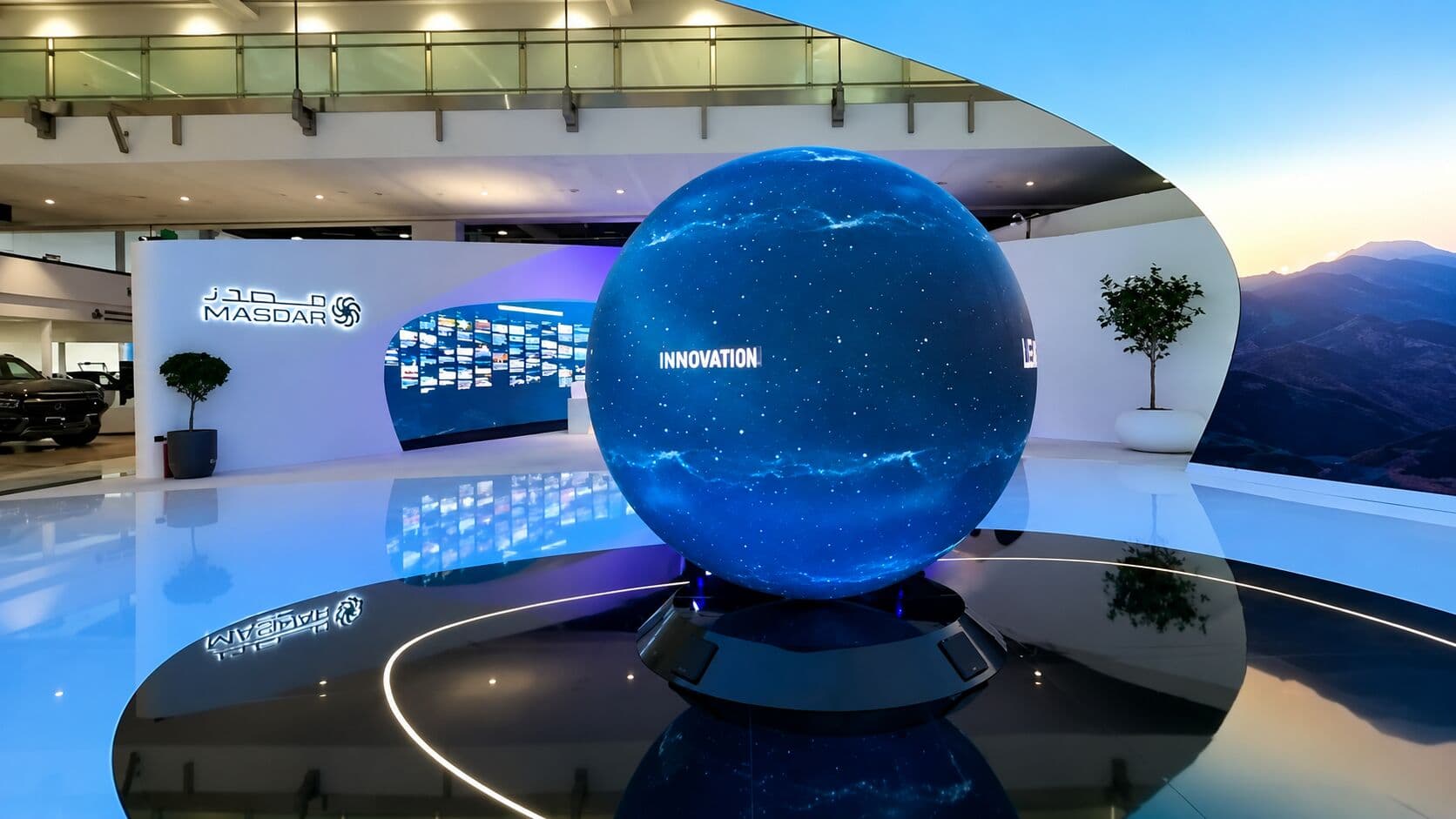
Spherical LED displays are becoming the centrepiece of exhibition stands. This one, on a Masdar stand, shows why.
What you are looking at
The photo shows a large LED sphere on the Masdar stand, mounted on a low black plinth in the middle of a glossy black reflective floor. The sphere is running a deep-blue starfield with the word 'INNOVATION', and its reflection doubles the effect on the floor below.
Behind it, a curved white wall carries the Masdar logo and a wide screen of image tiles, with potted trees and a landscape-print backdrop completing the set.
Why spheres are trending
A flat screen has a front and a back; a sphere does not. It reads from every direction, which makes it ideal for island stands and lobbies where visitors approach from all sides. It also photographs well, so it tends to become the image people share from an event.
- Visible from every angle
- A natural focal point for island stands
- Strong photo and social-media appeal
- Suits globe, planet and data-visualisation content
The method: content made for a curve
Sphere content cannot simply be a video file: flat footage stretches at the poles and pinches at the edges. Content is rendered to an equirectangular map that matches the sphere's pixel layout, then previewed on the actual sphere before the show so text such as 'INNOVATION' stays readable where visitors will stand.
Planning one
The main decisions are diameter, mounting (floor plinth or suspended) and the viewing positions. A reflective floor, as in this stand, is an inexpensive way to make a sphere look twice its size.